If you have ever hesitated before trying restraints because of a quiet fear — What if it cuts off circulation? What if it damages a nerve? What if we can't get them off fast enough? — you are not being paranoid. You are being responsible. Physical safety is the single most legitimate concern in restraint intimacy, and the good news is that it is also the easiest one to solve with a little knowledge.
This guide walks you through the basic anatomy of the wrist and ankle, explains exactly how tight a restraint should be, and shows you what to look for in equipment so that safety is built into the experience rather than bolted on afterwards.
Why the Wrist Deserves Respect
The human wrist is a narrow corridor packed with important hardware. Three major nerves pass through it: the median nerve (running through the carpal tunnel on the palm side), the ulnar nerve (along the pinky side), and the radial nerve (along the thumb side, closest to the surface). The radial nerve is the one most commonly irritated by restraints because it sits shallow against the bone on the thumb side of the wrist.
Compression injuries almost never come from a few minutes of moderate pressure. They come from three preventable mistakes: restraints that are far too tight, restraints with hard or narrow edges that concentrate pressure on a single line of skin, and long sessions where a bound partner pulls hard against the restraint in one fixed position.
The 2-Finger Rule
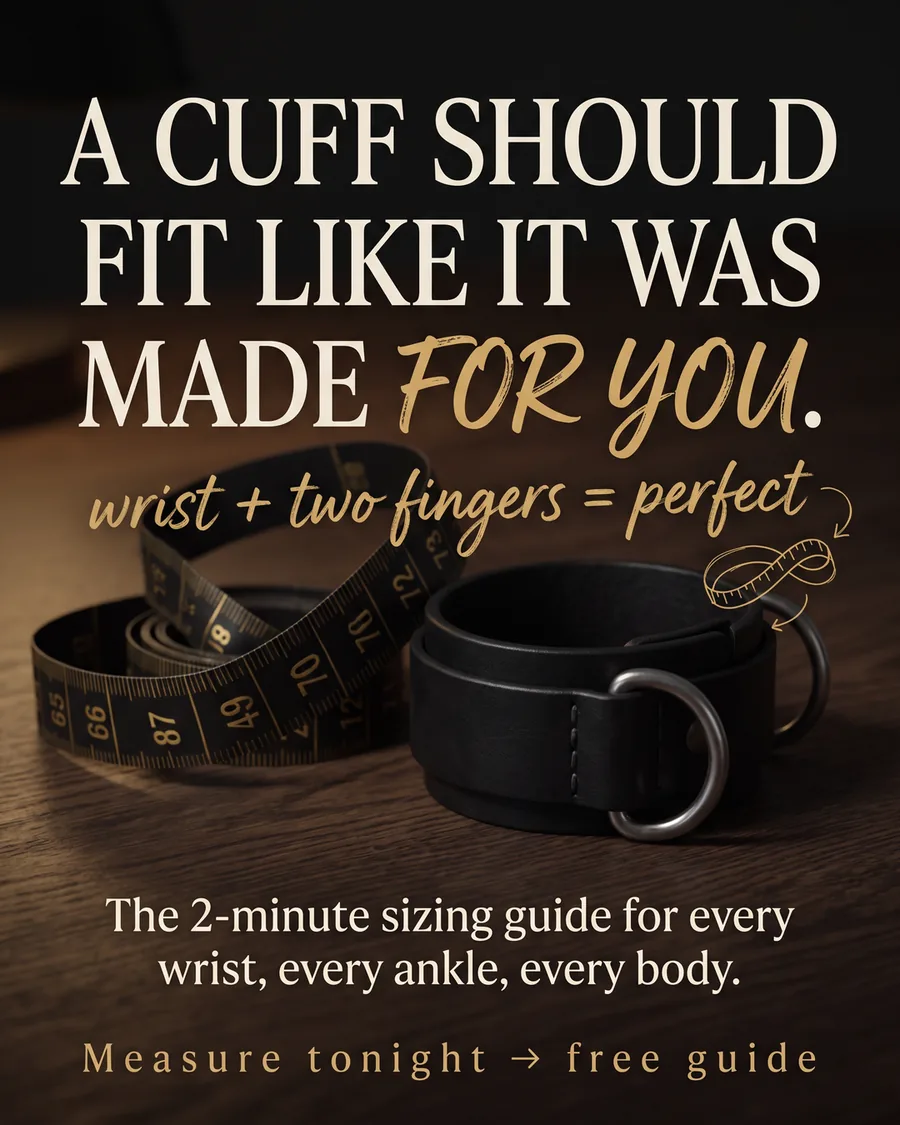
The industry-standard tightness check is beautifully simple: you should be able to slide two flat fingers between the restraint and the skin, comfortably, at any point around the wrist or ankle.
Two fingers of space means the restraint can hold position and create the feeling of being bound without compressing blood vessels or nerves. If you can only fit one finger, loosen it. If you can fit your whole hand, the cuff will slide and chafe. Check the fit again a few minutes into the session — tissues shift, and a fit that was fine standing up can change lying down.
Warning Signs Every Couple Should Know
Agree in advance that the bound partner will report any of the following immediately, and that play pauses the moment they do:
- Tingling, pins-and-needles, or numbness in the fingers or toes
- A hand or foot that feels cold compared to the rest of the body
- Skin turning pale, bluish, or deep red below the restraint
- Sharp, localized pain at any single point under the cuff
- Loss of grip strength or difficulty moving fingers
None of these are emergencies if you respond within seconds — which is exactly why the next section matters more than any other.
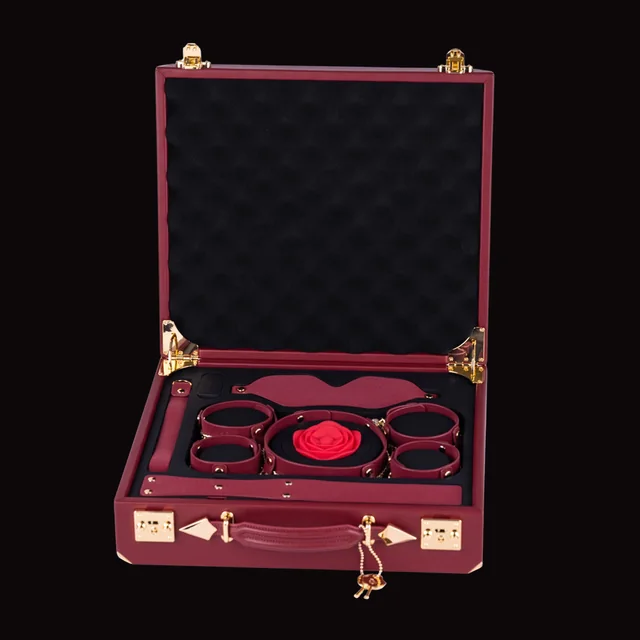
The Crystal Edition
Six pieces · Hand and foot restraints, neck brace, spanker, rose gag, eye mask — in its own locking case.
Quick-Release Is Not Optional
The difference between well-designed restraint gear and novelty gear usually comes down to one question: how fast can you get out? Metal handcuffs with lost keys, tight knots that jam under load, and buckles that require fine motor skills in the dark are all common causes of panic and injury.
Look for quick-release buckles, snap hooks, or wide Velcro-backed straps that can be undone in under three seconds with one hand. Keep safety shears within arm's reach if you ever use rope or anything tied. The ability to release instantly is what makes deep relaxation possible in the first place — the body only surrenders when it trusts the exit.
What Ergonomic Design Actually Means
A safe cuff distributes pressure across a wide, padded surface instead of a thin line. That means a strap width of at least four to five centimeters, a plush or padded inner lining (soft leather, velvet, or fleece), rounded and finished edges with no exposed rivets against the skin, and D-rings positioned so the pulling force is spread across the whole cuff rather than one stitch line.
To avoid nerve pressure, never use rigid or sharp-edged restraints. Opt for ergonomic cuffs with plush inner padding and quick-release hardware. This is the construction standard we build to across the SIN Premium collections: wide padded interiors, generously proportioned straps, and hardware designed to release in a single motion.
A Simple Pre-Session Safety Ritual
Before every session: inspect the gear for cracked stitching or bent hardware, agree on a safeword and a non-verbal signal, apply the 2-finger rule after fastening, and place the release mechanism where the free partner can reach it without searching. During the session, check in on sensation every ten to fifteen minutes and encourage small position changes.
Restraint play done this way is remarkably safe. The fear of injury is valid, but it is a fear of bad equipment and missing knowledge, not of the practice itself. Solve those two things, and what remains is simply trust, sensation, and play.
A Note on Our Own Standards
The criteria above are the ones we design to. Every SIN Premium set is built around wide padded interiors, generous strap widths, multi-point D-rings, and hardware that releases in one motion — hand-finished and inspected in our own atelier before it ships.