It's the quiet worry behind many abandoned carts: What if they don't fit? Wrists come slender and broad; ankles come narrow and athletic and generously curved — and 'one size fits all' has burned everyone at least once. Nobody wants an intimate moment interrupted by a cuff that pinches, gapes, or simply won't close.
Good news on two fronts: measuring yourself takes two minutes with household items, and modern adjustable systems have made true fit failures largely a solved problem — if you know what to look for.
Measure in Two Minutes
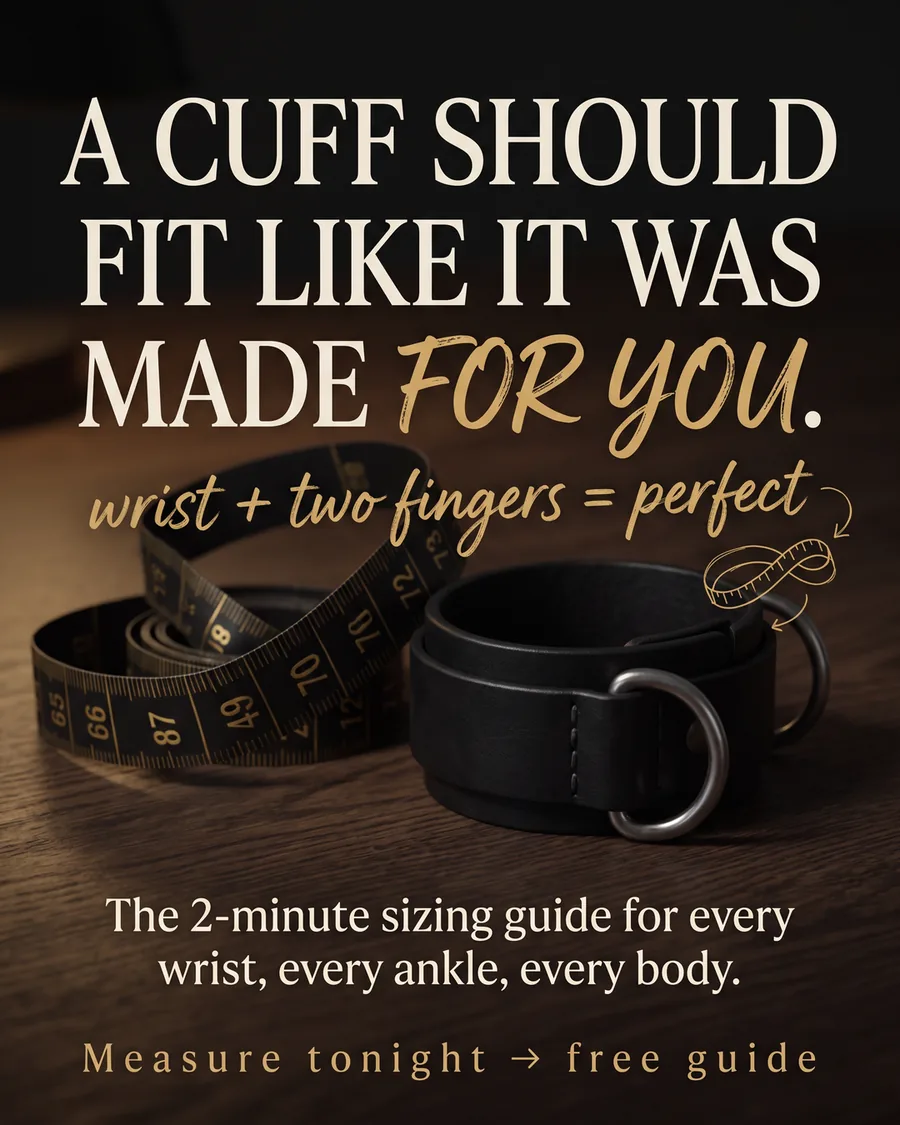
You need a flexible measuring tape — or a phone-charging cable and a ruler. Wrap the tape snugly (not tight) around the narrowest part of the wrist, just below the wrist bone, and note the number. Repeat at the ankle, just above the ankle bone. Measure both sides — small asymmetries are normal — and use the larger figure.
Typical adult ranges, for orientation: wrists roughly 14–20 cm, ankles roughly 19–28 cm. Wherever you fall — including outside those ranges — is simply a specification, not a problem. Bodies are data, and good design accommodates data.
The Fit Formula: Your Number Plus Two Fingers
A correctly fitted cuff equals your circumference plus room for two flat fingers between cuff and skin — the universal safety standard that keeps pressure off nerves and blood vessels. So a cuff's usable range must contain your measurement plus about 2–3 cm. When a product lists 'fits 15–22 cm', check that your wrist plus the allowance sits comfortably inside that window, not at its very edge — hardware at the extreme end of its range holds least securely and least comfortably.
Rigid Cuffs vs. Adjustable Straps: Know the Difference
Rigid or fixed-size cuffs (solid metal rings, sized leather bands with fixed snap points) offer a beautiful, jewelry-like feel — but they demand an accurate size match and offer no forgiveness. They're a fine second purchase, once you know your numbers and preferences.
Fully adjustable strap systems are the correct first answer for almost everyone: a wide padded band with a buckle or slide running across a long adjustment range, closing to exactly your circumference at any point along the strap. One product genuinely fits a household of different bodies — and fits the same body across natural daily fluctuation.
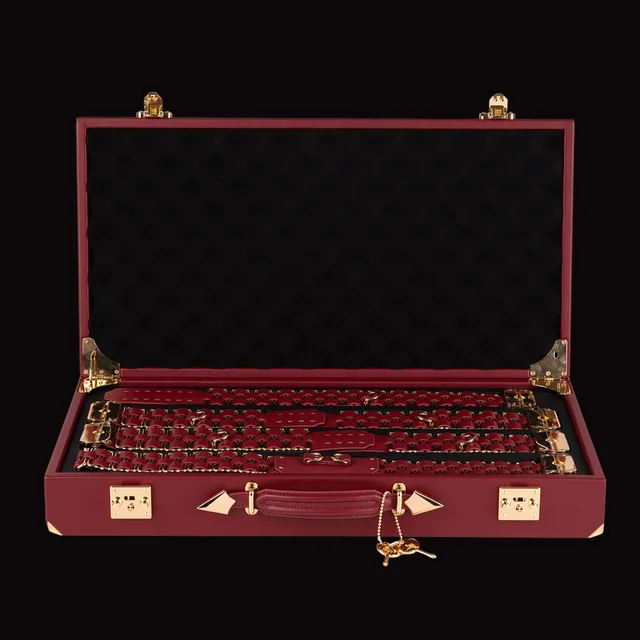
The Keen Bound Edition
Four pieces · Wrist and ankle restraints, neck control collar, torso restraint belt — adjustable throughout.
The Features That Make 'Adjustable' True
Not all adjustability is equal. The checklist:
- A long, continuous adjustment range (buckle with many holes, or infinite slide) rather than two or three snap positions
- Multi-point D-rings, so connection points stay correctly placed at any tightness
- Padding that runs the full strap length — so the lining, not bare strap, meets skin at every size
- Wide profiles (4 cm and up) that distribute pressure on slender and broad limbs alike
- Excess-strap keepers, so unused length tucks away cleanly at smaller settings
This is exactly the architecture behind our own adjustable sets at SIN Premium, whose multi-point D-rings and full-length padded straps are built to accommodate virtually all wrist and ankle proportions — fit engineered in, rather than hoped for.
Fit Notes for Real Bodies
Slender wrists: prioritize long adjustment ranges reaching small circumferences, and padding that stays under the buckle at the tightest settings. Broader wrists and ankles: confirm the stated maximum with your plus-two-finger allowance, and favor wide straps — narrow bands pinch more as circumference grows. Sensitive skin: seek plush linings (velvet, soft sealed leather) and hypoallergenic hardware that is solid rather than plated. And in every case, do a first fitting outside the bedroom: fasten, apply the two-finger check, move for a few minutes, confirm nothing pinches or slides.
The Takeaway
Two measurements, one plus-two-fingers rule, and a preference for genuinely adjustable, padded, multi-point systems — that's the entire science. Fit anxiety is the most fixable barrier in the category: your body was never the wrong size. Some products were just the wrong design.